
No-seasoning cash-out refinance
Can You Cash-Out Refinance a Rental Right After You Buy It?
By Bryan Maddex, NMLS 511837. Updated October 2026.
Often, yes. Some DSCR lenders will refi you right away. The wait isn’t usually the problem. The value is.
A lot of lenders will refi you on day one but cap you at what you paid. A shorter list will use the new appraised value. That’s the difference between getting some of your cash back and getting most of it.
You’ll hear that you have to wait 6 to 12 months. That’s true on some loans. Not on all of them.
I’ve closed with about 80 lenders, out of 260+ I can access.
Which lenders do no-seasoning cash-out refis?
Not most of them. More than there used to be.
A couple of years ago there was a very small handful of lenders that would do a no-seasoning cash-out. Now there’s about a dozen. A lot more will use your purchase price plus your renovation cost. That’s not really no-seasoning, but it’s access to more money than we had two years ago.
Guidelines change every few weeks. So when a lender says “no seasoning,” ask one thing. Which value are you using?
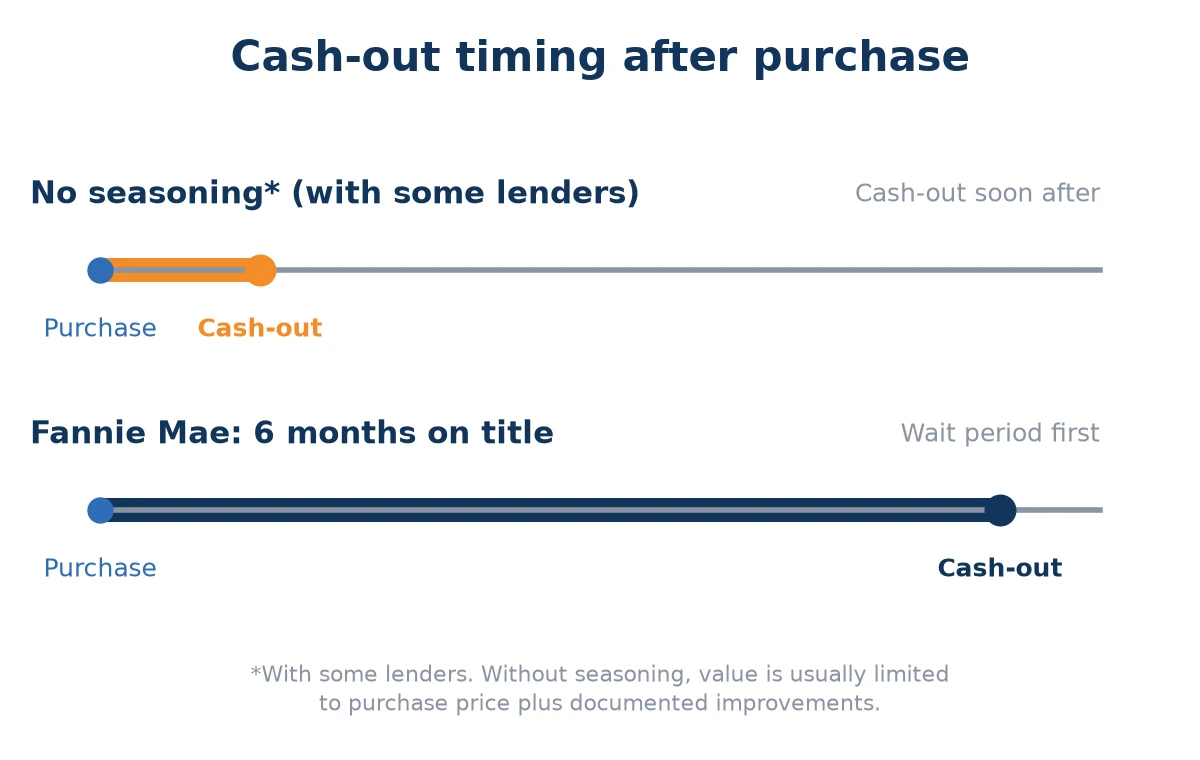
No seasoning vs. delayed financing: what’s the difference?
Delayed financing. You buy with cash, then refinance soon after to get that cash back. With Fannie Mae, Freddie Mac, and some lenders, the value is capped at your purchase price for the first 6 months of ownership. Some programs add your documented costs + your purchase price. A limited few non-QM/DSCR lenders will allow you to use the full appraised value with no seasoning time required.
No-seasoning cash-out. You refinance soon after you buy, and the lender uses the new appraised value. This is the one BRRRR investors want. It’s the shorter list.
BRRRR refi. The refinance step of buy, rehab, rent, refinance, repeat. It can be either of the above. If you bought with hard money or a private loan, it can also be a rate-and-term refi that pays that loan off. With some lenders, that changes the timing rules. Guidelines change.
| How you bought | Value the lender uses | Who offers it | |
|---|---|---|---|
| Delayed financing | Cash | Fannie Mae, Freddie Mac and some lenders cap value at purchase price for the first 6 months (some add documented costs) | Agency and many DSCR lenders |
| No-seasoning cash-out | Cash or financed | New appraised value | A shorter list of DSCR / non-QM lenders |
| BRRRR refi (rate-and-term) | Hard money or private loan | Depends on the program | Agency and DSCR, depending on the file |
My team and I can close loans in 48 states plus Washington, D.C., depending on the product and program.
Is it based on the appraised value or the purchase price?
It depends on the lender and how long you have owned it.
You’ll run into three answers:
- Purchase price only. Common inside the first 6 months, and the standard on agency loans. Fannie Mae has a 6-month seasoning rule on cash-out, with a delayed-financing exception for cash purchases.
- Purchase price plus documented rehab. More lenders are doing this now. It gets you more than purchase price alone. It is not the full appraised value.
- Full new appraised value. The shortest list. This is the one people mean when they say “no seasoning.”
If you bought a heavy rehab at a good price, the gap between #1 and #3 is the whole deal. Know which one you’re getting before you order the appraisal.
Keep your settlement statement and every rehab receipt. Lenders in bucket #2 will want them.
What LTV can I get?
It moves with the lender and the file.
What drives it:
- Your credit score
- The DSCR ratio (rent vs. payment)
- Property type (single family, 2–4 unit, condo, short-term rental)
- Loan size
- Whether you take a prepayment penalty
- Which value the lender is using (see above)
Cash-out goes up to 80% LTV with some lenders; guidelines change. Not every file gets the top number. With some lenders, max LTV may be lower in the first months.
No seasoning plus no prepayment penalty is the expensive combination. You can have it. You will pay for it. If you plan to hold the property, a prepay can buy the rate down.
Does it work with a DSCR loan?
Yes. That is where most of the no-seasoning options live.
DSCR qualifies on the property’s rent, not your income. More on the ratio in the DSCR guide. Whether a lender pairs that with a no-seasoning cash-out is lender by lender. Varies by lender; not a commitment to lend.
Plan on paying a little more to pull equity out 30 or 60 days in instead of waiting 6 months. That’s the cost. The other side is the opportunity cost of letting that money sit.
A few things that still matter on a quick DSCR cash-out:
- Is it rented yet? Some lenders want a lease. With some lenders, a vacant property can use market rent.
- Short-term rental? Some lenders will count Airbnb income. Fewer will on a property you just bought.
- LLC? You can usually close a DSCR loan in an LLC or in your personal name.
- Reserves. Many lenders want some money in the bank after closing. Some allow no reserves. It varies by lender.
DSCR is light doc. It is not no doc. Credit, assets, and the ratio still get underwritten.
What should I line up before I buy?
Talk to your lender before you pay cash. Not after.
How you buy changes how you can refinance. A cash purchase, a hard money loan, and seller financing each point to a different refinance path. If you know the exit before you close on the purchase, you pick the purchase that gets you there.
Begin from the end.
Real Estate Investing with Coach Carson
Watch: related episodes
#439: Cash-Out Refi Explained: How to Tap Your Equity Without Killing Cash Flow (Aug 25, 2025). Show notes · YouTube
#502: No W-2 or Tax Returns? DSCR Loans Explained! (2026) (Aug 24, 2026). YouTube
FAQ
How soon after buying a rental can I do a cash-out refinance?
With some DSCR lenders, right away. The bigger question is whether the lender will use your purchase price or the new appraised value. Inside the first 6 months, many lenders cap the value at purchase price or purchase price plus documented rehab.
How long do I have to own a rental before I can refinance it?
Many lenders do not have a minimum seasoning period on a rate-and-term refinance, but some DSCR lenders do still require one.
Should I wait for the 6-month mark to get a better cash-out?
Not always. No-seasoning lenders are a little higher, but if rates rise while you wait, that can cost more than you save. I don’t advise holding out for the six-month mark just for the sake of it. Price both.
How much can I cash out of a rental?
Up to 80% LTV with some lenders; guidelines change. Not every file gets the top number, and which value the lender uses matters as much as the LTV.
Is delayed financing the same as a no-seasoning cash-out?
No. Delayed financing gets your cash back after an all-cash purchase. With Fannie Mae, Freddie Mac, and some lenders, the value is capped at your purchase price for the first 6 months of ownership. A no-seasoning cash-out uses the new appraised value. That is the shorter list of lenders.
Can I do a BRRRR refinance with a DSCR loan?
Yes. DSCR is how a lot of investors refinance out of a BRRRR. The loan qualifies on the property’s rent, not your personal income.
Do I need the property rented before I refinance?
Not always. Some lenders want a signed lease. With some lenders, a vacant property can use market rent. It depends on the lender.
Which states do you do no-seasoning DSCR cash-outs in?
My team and I can close loans in 48 states plus Washington, D.C., depending on the product and program. Which lenders will do a no-seasoning cash-out still varies by state. Details on the DSCR loans page.
Want me to look at your refinance?
If you just bought, or you’re about to, send me the numbers. Purchase price, rehab cost, rent (or expected rent), credit score range, and the state. I’ll tell you which value you can likely get and which lenders fit. If it doesn’t work yet, I’ll tell you. Talk to me before you pay cash, not after.
The short survey below takes a few minutes.
Survey not loading? Open the DSCR refinance survey in a new tab.
If you’d rather talk it through, pick a time that works for you on my calendar.
This is not a rate quote or a commitment to lend. Programs and guidelines change often.