
Paying points
Should I Pay Points on a Rental Property Loan?
By Bryan Maddex, NMLS 511837. Updated October 2026.
Only if you’ll keep the loan long enough to earn the cost back. One point is 1% of the loan size, paid up front, to buy a lower rate.
What is a point on a mortgage?
A point is a fee you pay at closing to lower your rate.
For example, on a $300,000 loan, one point is $3,000 and two points are $6,000 (not a rate quote).
Points are not the same as closing costs. Appraisal, title, and the credit report are separate.
Why do you quote 0, 1, and 2 points?
Because that’s the comparison that matters. I’m going to quote you 0, 1, and 2 points almost every time, side by side, so you can see what each point buys.
Some days I’ll show more options. The rate, the cost in points, the cost in dollars, and the break-even are all on the same page.
How long does it take to break even on points?
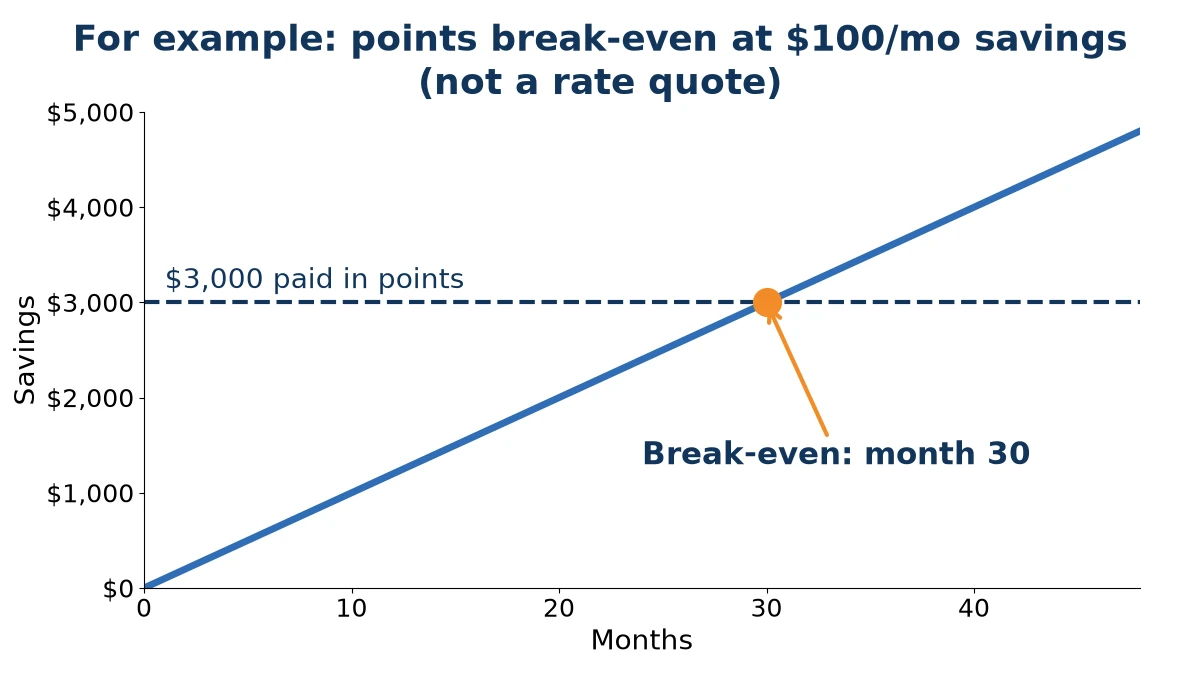
Divide the cost of the points by what they save you each month. That’s your break-even in months.
Break-even (months) = cost of the points ÷ monthly savings
For example, if points cost $X and save $Y a month, break-even is X/Y months (not a rate quote).
Is it worth paying more than two points?
Usually not. You get very diminishing returns past two points. Each extra point buys less rate than the one before it, so the break-even gets longer.
Should I pay points if I might sell or refinance soon?
Probably not. If you sell or refinance before the break-even, the points cost you money.
Think about the exit before you pick the points:
- Planning to hold for years? Points can make sense.
- Planning a refinance when rates drop, or a sale in a couple of years? Zero points, or close to it, is usually the cleaner choice.
- On a DSCR loan, check the prepay too. Points and the prepayment penalty both trade money now for a better rate later. Don’t stack both if you might leave early.
What’s the catch with “one point” in online ads?
Ask for total points, not just the lender’s points.
Some ads show a rate that assumes points or fees. Get every quote in dollars.
Can the seller pay my points?
Sometimes. Seller concessions can go toward closing costs, and with many lenders that can include points.
On DSCR loans, seller concessions run 6% with many lenders, and up to 9% with a couple of them; guidelines change. Fannie Mae allows less on an investment property. One way to keep money in your pocket is to get the seller to pay your closing costs.
FAQ
What is one point on a mortgage?
One point is 1% of the loan size, paid at closing to lower your rate.
Should I pay points on an investment property loan?
Only if you’ll keep the loan past the break-even. If you might sell or refinance soon, zero points is usually cleaner.
How do I figure the break-even on points?
Divide the cost of the points by the monthly savings. For example, if points cost $X and save $Y a month, break-even is X/Y months (not a rate quote).
Is it worth paying more than two points?
Usually not. Returns diminish past two points, so the break-even gets longer.
Are points the same as closing costs?
No. Points buy down the rate. Closing costs are fees like the appraisal, title, and credit report.
Can the seller pay for my points?
Often, yes, through seller concessions, up to the lender’s limit. On DSCR loans that’s 6% with many lenders and up to 9% with a couple; guidelines change.
Want 0, 1, and 2 points side by side?
Want a quick quote? Shoot me the purchase price, down payment, rent, and credit score, and state. I’ll show you 0, 1, and 2 points with the break-even on each.
Rather talk it through first?
Related: Prepayment penalties · Broker vs. bank · DSCR loans
This is not a rate quote or a commitment to lend. Programs and guidelines change often.