
BRRRR financing
How to Finance a BRRRR
By Bryan Maddex, NMLS 511837. Updated October 2026.
You finance a BRRRR in two loans: one to buy and rehab, and one to refinance into a long-term rental loan, usually a DSCR loan. The refinance is where most BRRRR deals win or lose, and how you buy decides what refinance you can get. Plan the exit before you close on the purchase.
What is BRRRR?
Buy, rehab, rent, refinance, repeat.
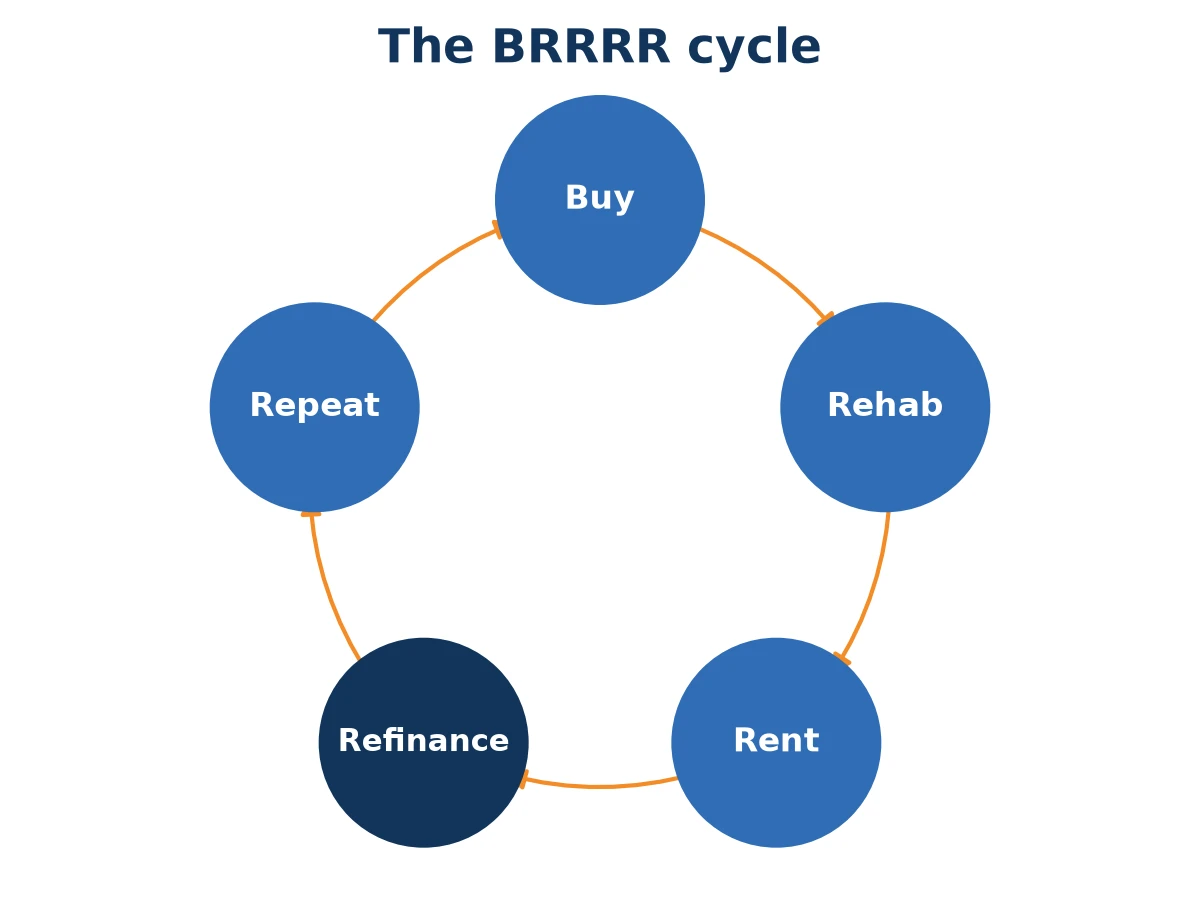
You buy a property below what it’ll be worth, fix it, rent it, then refinance to pull your cash back out for the next one. The goal is to leave as little of your own money in the deal as possible.
The whole thing depends on one number: how much the refinance lender will lend against. Your purchase price, your purchase price plus rehab, or the new appraised value.
DSCR calculator
DSCR = monthly rent ÷ PITIA
Rent covers the full payment 1.20 times. Whether that ratio works, and at what price, depends on the lender.
For example, over 30 years at the sample rate in the calculator (not a rate quote). Runs in your browser; nothing you type is saved or sent.
How do I pay for the purchase and rehab?
The usual options:
- Cash. Simple to buy. But it sets up the refinance as a delayed-financing or cash-out loan, with its own value rules.
- Hard money or private money. A short-term loan for the purchase and often the rehab. The refinance pays it off.
- A HELOC on another property. Short-term money you can draw when you need it. Once the rehab is done, a cash-out refinance pays the HELOC back, and you do it again. See investment HELOCs.
- Seller financing. If the seller will carry it for a few months, the refinance can look like a rate-and-term refinance, not a cash-out.
- A partner. One brings the cash, one brings the credit or the work.
Pick the purchase loan with the refinance in mind. Not the other way around.
Why does how I buy change the refinance?
Because lenders treat a refinance that pays off a loan differently from one that hands you cash.
If you bought with cash, pulling it back out is a cash-out refinance. Many lenders cap the value at your purchase price for the first several months. Some use purchase price plus documented rehab. With a small handful of lenders, you can use the new appraised value right away. Lender guidelines are always changing, and we track which lenders have which seasoning guidelines.
If you bought with hard money or private money, the refinance may be a rate-and-term refinance that pays off that loan. Timing rules can be easier with some lenders.
More on value and timing: no-seasoning cash-out refinance.
When can I refinance a BRRRR?
It depends on how you bought and which lender takes the refinance.
You don’t always have to wait 6 to 12 months. Some DSCR lenders will refinance as soon as the rehab is done and the property is rent-ready. With some lenders the property can be vacant at refinance; others want a lease.
The faster you want out, the shorter the lender list, and the more you may pay for it. No seasoning plus no prepayment penalty is the expensive combination.
How much cash can I get back out?
That depends on the max LTV and which value the lender uses. Cash-out goes up to 80% LTV with some lenders; guidelines change.
Do the math backward before you buy:
- Estimate the after-repair value.
- Multiply by the lender’s max LTV.
- Subtract closing costs.
- Compare that to everything you put in: purchase, rehab, holding costs.
If the gap is bigger than you can leave in the deal, change the deal. Not the appraisal.
Then check the rent. The refinance also has to pass the DSCR test: rent ÷ full payment. Some lenders go below 1.0 at a cost, and some offer no-ratio options with no minimum ratio at all. Use the DSCR calculator.
What kills a BRRRR refinance?
- The appraisal comes in low.
- The rent doesn’t cover the new, bigger payment.
- The lender caps value at purchase price because of timing.
- Rehab costs aren’t documented.
- The hard money loan matures before the refinance is ready.
Most of these are fixed before you buy. Keep every receipt and your settlement statement. Talk to the refinance lender before you close on the purchase.
Real Estate Investing with Coach Carson
Watch: related episodes
#476: 5% Down Rental Loans: When They Work (And When They Don’t) (Feb 23, 2026). Show notes · YouTube
#370: The Best Ways to Finance & Scale a Rental Portfolio (Even With No Job!) (Nov 18, 2024). Show notes · YouTube
FAQ
What loan do you use to refinance a BRRRR?
Usually a DSCR loan, which qualifies on the property’s rent instead of your income. A conventional cash-out can also work if you qualify and the timing fits.
How soon can I refinance after a BRRRR rehab?
With some DSCR lenders, as soon as the rehab is done. The bigger question is whether they’ll use the new appraised value or what you paid.
Is it better to buy a BRRRR with cash or hard money?
It depends. Hard money can make the refinance a rate-and-term instead of a cash-out, which can change the timing rules. Plan it with your refinance lender first.
Can I buy with hard money and refinance into a DSCR loan?
Yes. That’s a common BRRRR path: hard money or a HELOC to buy and rehab, then a DSCR refinance to pay it off. Line up the refinance lender before the hard money loan’s clock starts.
Can I get all my money back out of a BRRRR?
Sometimes. It depends on the after-repair value, the lender’s max LTV, which value they use, and your total cost in.
Do I need the property rented to refinance?
Not always. With some lenders the property can be vacant at refinance; others want a lease.
Working on a BRRRR?
Send me the purchase price, rehab budget, expected after-repair value, expected rent, credit scores, and the state. Before you buy is the best time.
Rather talk it through first?
This is not a rate quote or a commitment to lend. Programs and guidelines change often.